
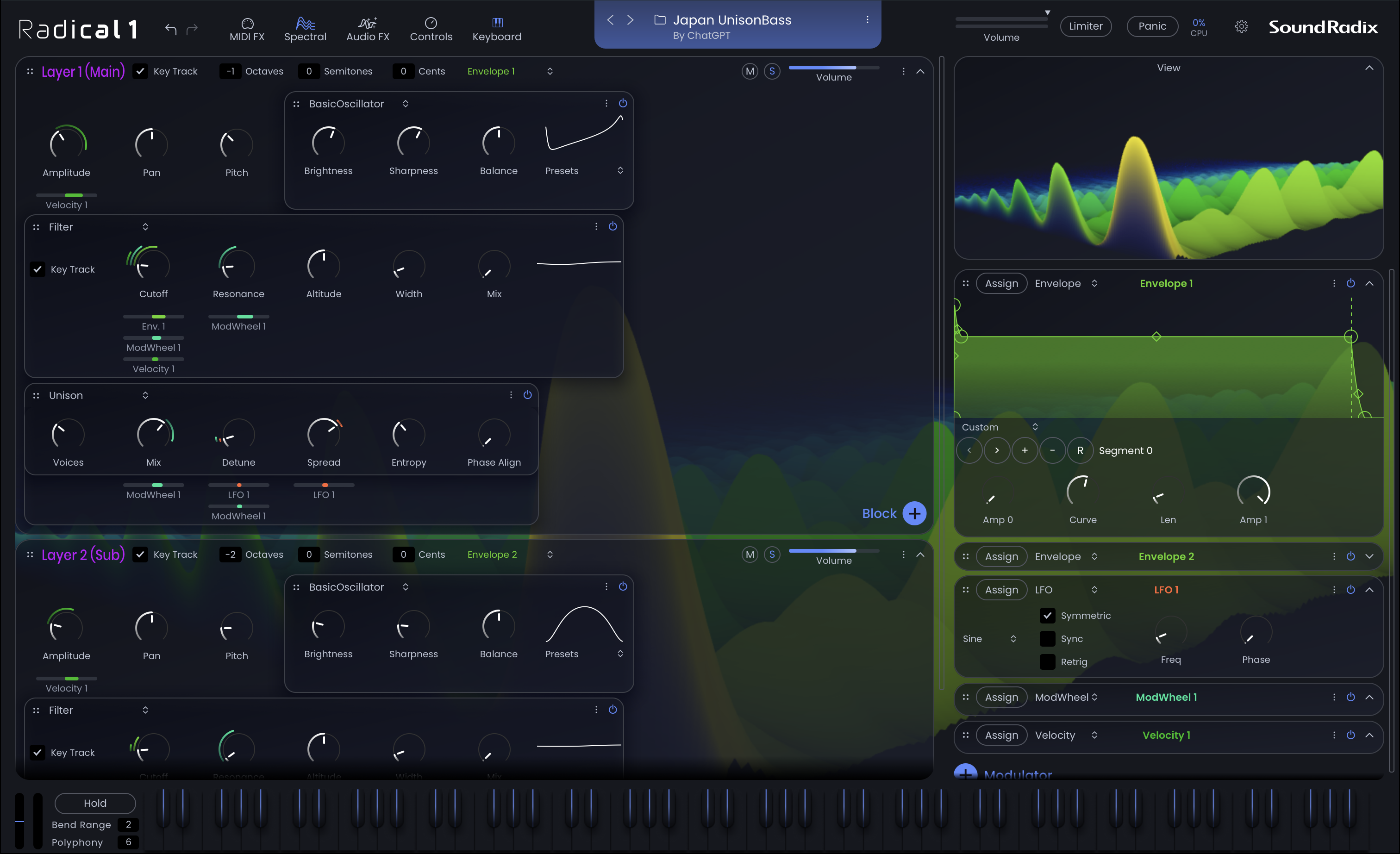
Your Next Radical1 Preset Starts with a Sentence
"I Don't Have Ears, But We Can Still Make Bangers": A Co-Pilot’s Guide to AI Sound Design in Radical1
How we taught the AI to generate Radical1 synth presets
R
adical1 saves all its synthesizer presets as plain, readable JSON. That opens up an entirely new approach to sound design. Because the format is text-based, you can share presets directly with an AI model, describe what you're hearing in your head, and get a working synthesizer patch back in minutes. Not a starting point — an actual loadable preset, ready to tweak and make your own.
This creates a new kind of AI-assisted sound design workflow, where ideas can move quickly from imagination to a functioning synth preset.
But getting there required one important breakthrough.
The Breakthrough: Teaching the AI the Synth Architecture
The key step was introducing a reference preset designed to expose the full architecture of Radical1. We created a special preset called:
This preset intentionally contained every available block type and modulation source in Radical1.
In effect, it acted as a living schema of the synthesizer — a complete example of how Radical1 organizes oscillators, modulation routing, effects, and layers inside its JSON preset format.
Instead of guessing the preset structure, the AI could now learn directly from a working example.
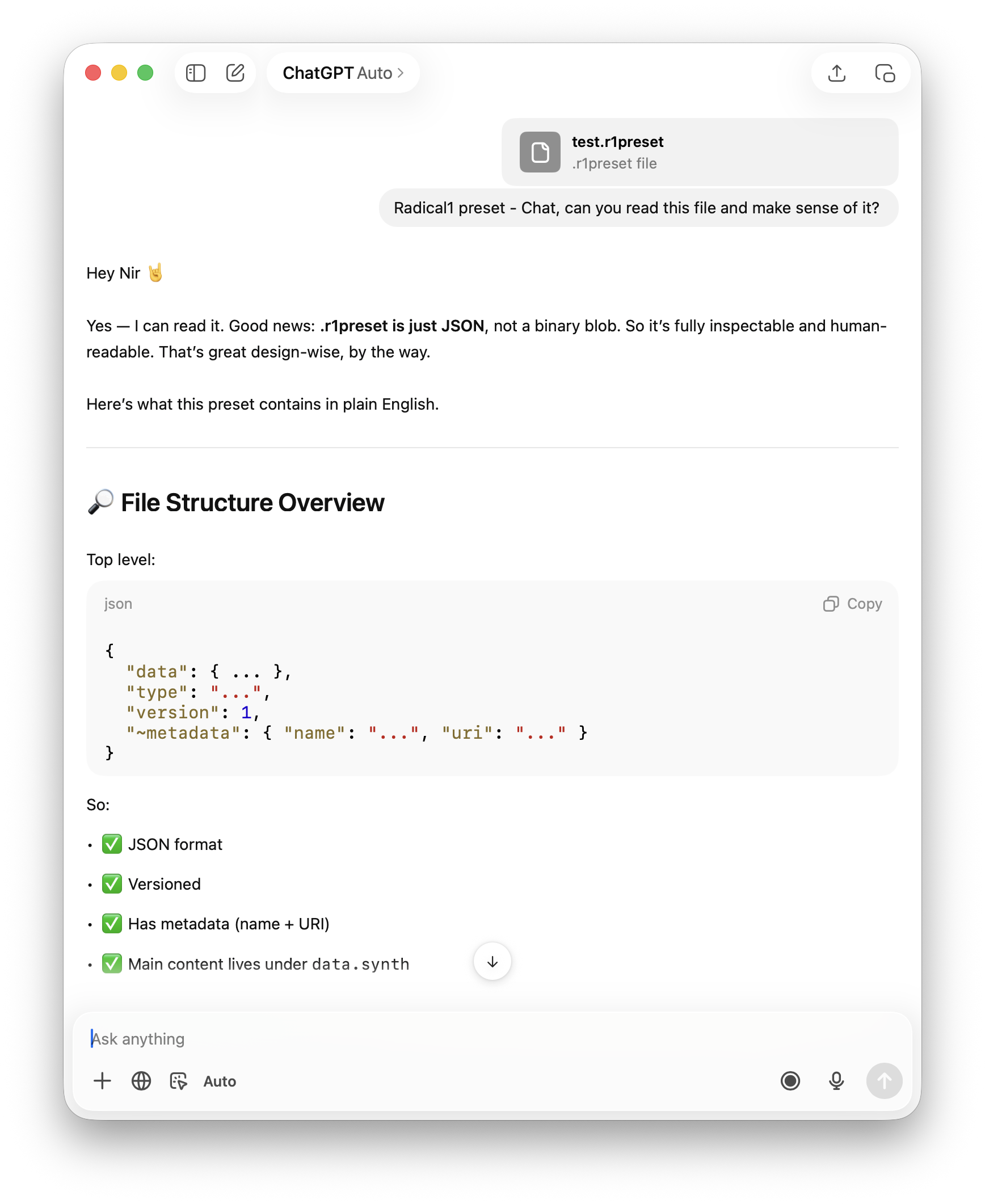
Step 1 — Provide a Reference Preset for the Synth Architecture
The Omni preset exposed:
• all block types
• parameter structures
• modulation routing format
• time-domain effects
• layer structure
• modulation sources
This allowed the AI to inspect the JSON and understand how Radical1 organizes its data. Instead of guessing the format, the AI could learn directly from a valid synthesizer preset structure.
Step 2 — Use the Preset as a Structural Template for AI
Once the preset structure was understood, the Omni preset became a reference library embedded inside a synth patch.
The AI could safely:
• copy block definitions
• reuse modulation structures
• adjust parameters
• rearrange blocks
This dramatically improved reliability. Instead of generating arbitrary JSON, the AI was now modifying real Radical1 preset templates.
Step 3 — Generate New Synth Presets by Modifying Templates
From that point on, the workflow became very simple:
Working preset
↓
Modify parameters or blocks
↓
Generate new preset
↓
Test in Radical1.
Because the AI was now working from known-valid preset structures, the generated synth patches began loading consistently. What started as an experiment quickly turned into a practical AI-powered preset generation workflow.
Why this worked
The Omni preset effectively acted as three things at once:
JSON documentation + block reference library + modulation schema
Once the AI could see how Radical1 stores oscillators, filters, modulators, and effects, generating new presets became reliable.
The general principle
If you want AI to generate presets for Radical1 modular additive synthesizer, provide a preset that contains:
• every block type
• every modulation source
• representative routing examples
This effectively teaches the AI the instrument’s architecture. Once the structure is understood, the model can generate new patches safely and creatively.
Learn from loading errors
Not every generated preset worked on the first try. When a preset failed to load, the fix was usually one of these:
• invalid block order
• unsupported modulation routing
• missing parameters
• incorrect IDs
The debugging workflow became:
Generate preset
↓
Load in Radical1
↓
If it fails → compare with working preset
↓
fix structure.
Over time the AI learned which preset structures were safe, and the success rate improved dramatically.
A New Workflow for AI-Assisted Sound Design
What started as a small experiment quickly turned into a surprisingly powerful workflow. By exposing the architecture of the synth through a single “Omni” preset, we effectively gave the AI a map of the instrument. From there, generating new sounds became less about guessing and more about collaboration.
The result is a new kind of sound design process: describe the sound you imagine, let the AI translate that idea into a working preset, then refine it with your ears and instincts. The machine handles the structure; the musician shapes the result.
For Radical1, this opens an exciting door. Synth presets are no longer just files you load — they become a language you can explore, share, and design with AI.